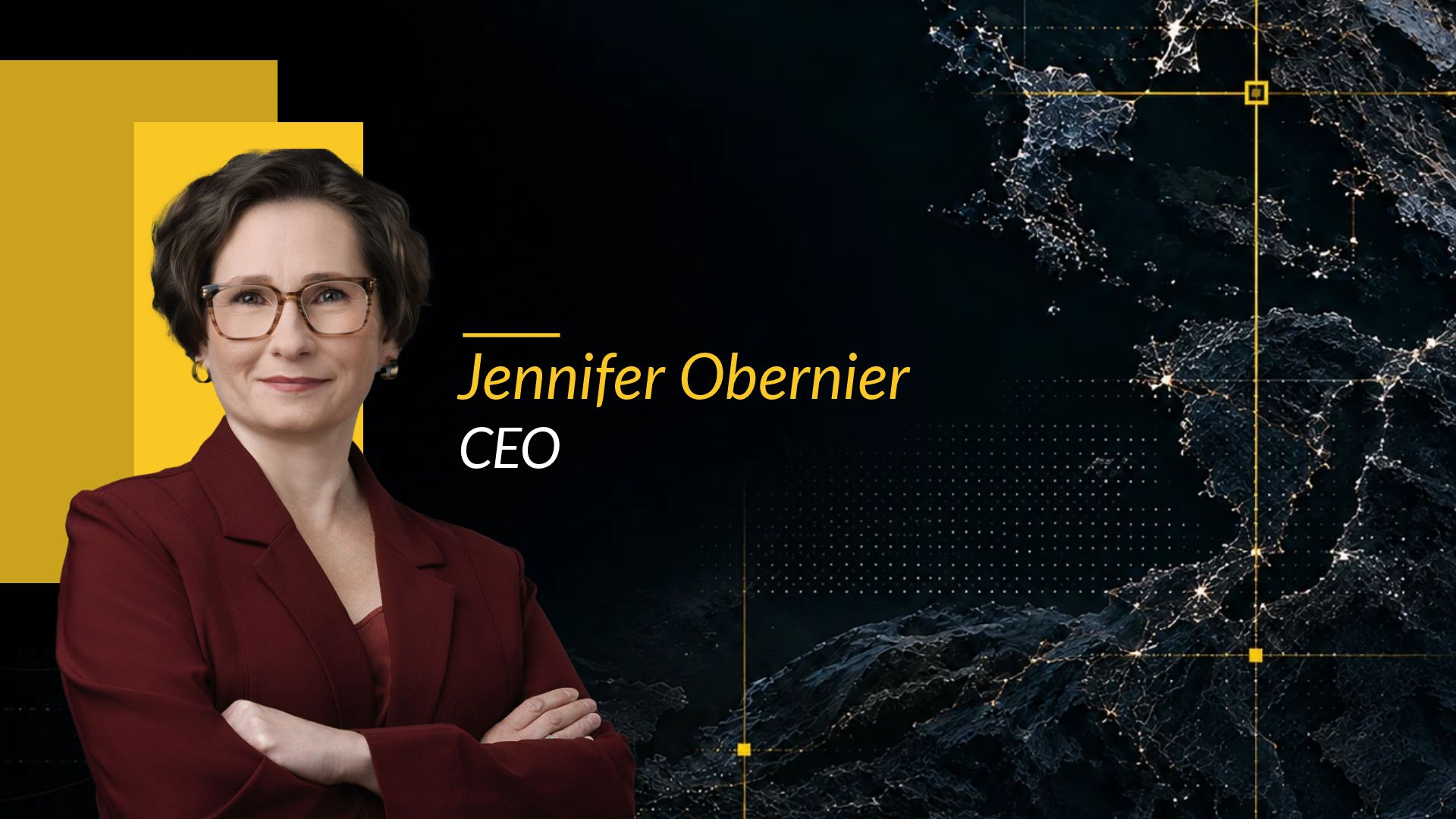
Science taught me to start with a question and be disciplined about what the evidence does and doesn’t support. For our customers, the question is almost always a decision, and decisions are made by people with predictable strengths and blind spots.
At the National Academy of Sciences, I watched rigorous policy recommendations go nowhere because they were written for scientists, not for the elected officials who had to weigh them against political realities. The science wasn’t the problem. The translation was. Accurate and usable are not the same thing.
That lesson shapes how Grist Mill works. We start by asking how a customer actually makes a decision, which tells us what data they need and how it should be presented. My doctoral training also covered how people take in information. When someone is reading one thing and hearing another, the brain can’t fully process both, and most people stop really hearing the speaker. So in our videos, the narration reinforces what’s on screen instead of competing with it.
It also guides how we use AI. I experimented with neural networks in graduate school and understood early that machines could connect disparate sources faster than people can. We’ve spent four years testing and shaping AI to discover, evaluate, and link commercial data. Customers don’t get a list of generic datasets. They get the specific data they need and how it connects to what they already have.
Just as important is knowing where AI stops helping. Like people, AI can get “creative.” That’s a strength when it opens pathways we hadn’t considered, and a risk when it drifts into something plausible but not workable. So a human checks the viability of a data solution before a customer licenses it. And when mission demands make that impossible, we tell the customer plainly that the recommendation is AI-generated.
AI is good at generating hypotheses. A scientist’s job is to test them.
The biggest delays come after a team picks the data it wants, when it has to vet the vendor, conduct market research, sort out terms of use and contracting, and get the data into its systems. Each step brings in different processes, including legal and security, often run consecutively, which is how an acquisition ends up taking nine to eighteen months. By then the mission has moved on, and sometimes the data isn’t even available anymore.
That’s the work our Commercial Data Infrastructure handles. We’ve already built the vendor relationships, licensing frameworks, workflows, APIs, and business processes required to use commercial data at scale, so a team can start with the data instead of the paperwork. We also deliver the data in a form teams can use, inside the systems they already work in, because acquiring data quickly doesn’t help if it then takes months to integrate.
In 2022, most customers were just getting comfortable with commercial data and were looking for a single bulk dataset to acquire. Many were still learning which types of commercial data existed, and often they only knew of one data vendor. We built Grist Mill to give customers more choices, to expose them to a greater diversity of vendors, and to make it faster to find, evaluate, and acquire the right commercial data. Grist Mill provided all this through a single trusted point of access, a promise that has not changed. What has changed is how far customers want to take it, and we meet them wherever they are on that path.
Today, mission requirements have matured how governments think about data. Customers now often seek smaller volumes of streaming data across four to six modalities that fuse with their existing data to address their use cases rapidly and cost effectively. They are also more likely to want to test a few similar datasets side by side before they commit to a year’s acquisition.
Customers also want data delivered differently than they did a few years ago. More teams want to query for exactly what they need through an API and have it appear in the platforms and systems they already use. Trust comes up much earlier as well. With synthetic and manipulated content entering operational workflows, teams want to know whether anyone has altered the data before they rely on it. Those conversations led directly to our standardized data dictionaries, metered APIs, and our partnership with Reality Defender.
Customers started using Grist Mill as infrastructure before we ever called it that. Commercial data now feeds operational platforms, AI models, and programs that integrators run for years. Teams need to be able to reach that infrastructure in whatever way works best for them. That can be through The Mill, our marketplace of more than 375 vetted vendors; through Millton, our chat-based AI for analysts; or by extending directly into their own applications and AI systems.
What customers rely on most is the work that happens behind the scenes. That includes the vendor relationships, licensing frameworks, workflows, APIs, and business processes required to use commercial data at scale. Agencies used to rebuild all of that every time a contract ended or a platform changed. With Grist Mill, they can build on what’s already in place.
Many of the people on our team came to Grist Mill after careers in the military, intelligence, and government. Matthew Barchick served as a Marine officer, Conn Wiseman spent a decade on active duty in the Marine Corps, and Phyllis George spent more than 20 years in federal government roles, including crisis management overseas. Colleen Fagan served as a Navy intelligence officer, Ty Fleming worked collections and targeting in support of special operations, and Casey Fallin provided intelligence support to special operations and joint teams.
I was at the Pentagon for about ten years, and I still remember what it was like to be on the other end, stuck waiting. A lot of customers are dealing with the same thing today. Most come to us knowing the name of a dataset they’ve heard about, but they haven’t always worked out exactly what they need. Because we’ve sat where they sit, we know what to ask. What decision are you trying to make? What will you have to justify to your boss later? What will your contracting officer and security team want to see before they sign off?
The answers often point to different data, or a different way of buying it, than the customer had in mind when they first called. Getting that right at the start saves them months spent on something that won’t answer their question or give them the output they need.